Showing posts with label coral reef. Show all posts

Sunday, 15 June 2014


Another year had passed and concerned people were celebrating World Ocean Day on June 8th. We all depend on a healthy and clean ocean for our very survival and the latest scientific research is painting a dismal picture of things to come. Most of us know we need to act to turn around the damage caused by unwise use, pollution, and over fishing. But few of us do anything.
This year’s World Ocean Day theme is, “Together we have the power to protect the ocean” and all over the globe small groups of people set out to make a difference.
 

Perhaps the smallest but most well meaning effort was on the tiny island of Langkawi just a few kilometers from the Thailand- Malaysia border. There the Andaman Resort operates a small coral nursery that both educates children and rehabilitates a tsunami ravaged coral reef.
This year the small band of young volunteers (and a couple of parents who wanted to get involved with their children) were busy maintaining the nursery, feeding the lobsters, and grafting tiny corals when World Ocean Day rolled around.
What could eight dedicated children do to save the sea; how could so few make a difference?


When the 2004 tsunami roared ashore, the huge wave swept tens of thousands of living corals off the fringing reef and up into the ancient rainforest. Over the last 4 years guests at the luxury resort have collected by hand about 100 tonnes of dead coral skeletons and carried them to the coral nursery.
There, with the assistance of resort staff, the dead coral rock is recycled into mini-Artificial Reef Modules that provide much needed shelter for young marine life and a stable substrate for corals to grow on. They are heavy, have ‘baby’ corals attached, and are difficult to move.
“But we want to do it! We want to take the corals out to the reef”, said Liam who was quickly backed up by his determined younger brother, Callum. Liam is one of the hard working volunteers that regularly return to the Andaman to work at the Coral Nursery. World Ocean day marked the fourth visit of his family since the end of 2013 and school holidays. Determined to become a marine biologist because of his Nursery experiences, Liam led the way.
 

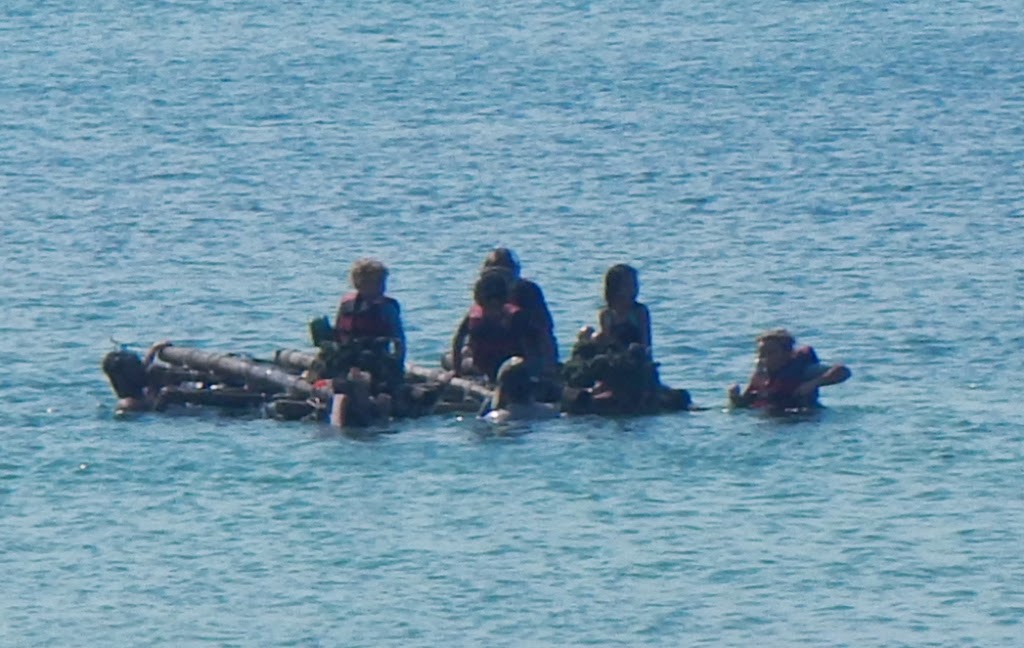
Bamboo from the rainforest served as a framework, odd pieces of rope and ‘strange’ knots worked as fastenings, and inner tubes from tires provided floatation. The kids built their own raft without any help and managed to load the mini- Artificial Reef Modules aboard. Plastic kitchen utensils splashed water over the living corals and swimmers in life jackets towed the raft out to the reef where the Modules were lowered to the ocean floor.
Coral reefs comprise the most diverse ecosystems on Earth but are now threatened with destruction. They occupy just over 0.15% of the world’s oceans, yet incredibly they provide a home for an estimated 25% of all marine species. They really are the “engine room” of the sea and their loss will cripple the marine environment on a global scale.


Productivity is higher than in other tropical waters and 6 million tons of fish are taken each year from the world’s coral reefs. Most of this stays in protein-poor countries. Langkawi’s community is largely dependent on local fisheries for protein and the next generation needs the Andaman Reef.

Biodiversity is the loudest catch cry in environmental research today. It is a measure of the complexity of an ecosystem and is now thought to be related to the health of the entire planet. Southeast Asian coral reefs have the highest levels of biodiversity of all the world’s marine ecosystems, perhaps the highest biodiversity since the beginning of life on Earth.


But, recent surveys show that 10% of the world’s coral reefs are already dead. It is estimated that another 60% of the world’s reefs are at risk due to destructive, human-related activities. Man’s threat to the health of reefs is particularly strong in Southeast Asia, where an appalling 80% of reefs are endangered. Sadly, Southeast Asian coral reefs are now the world’s most threatened, being impacted by the activities of man.
The global economic value of these tiny coral reefs is staggering, estimated at $30 billion annually. Southeast Asia’s coral reef fisheries alone yield about $2.4 billion annually. According to the WWF, the economic cost over a 25 year period of destroying one kilometre of coral reef is somewhere between $137,000 and $1,200,000. Conversely, the economic benefit of saving one kilometre of reef is the same.


The children worked most of the afternoon putting six Modules with 30 coral colonies in place. By doing something small but highly visible for Langkawi’s World Ocean Day, the children helped to focus attention on the plight of reefs around the world.
Sunburned, thirsty, scraped knuckles, and smiling, the children returned to shore and the cool of the rainforest to share their adventure with their parents.
Will their experience change the way they live? It has already.An email this morning from one of the parents said that her children were talking about recycling and hybrid cars.

The kids proved that even one person can make a difference and “Together we have the power to protect the ocean!”

goedenscience.blogspot.com
drgerrygoeden.blogspot.com
goedenshark.blogspot.com
geraldgoeden.blogspot.com
goedensnews.blogspot.com
goedenspress.blogspot.com
einsteinsnature.blogspot.com
youngmarinescientist.blogspot.com
gerryquotes.blogspot.com
goedenquotes.blogspot.com
underwaterinternet.blogspot.com
goedenmarineecology.blogspot.com

Saturday, 10 May 2014

"Vezo" a short film by Tod Lending


I wanted to share this wonderful little video with Andaman Sea readers. Overfishing and lack of management characterize fisheries in the tropics. 

Some 200 million people depend directly on coral reefs and a further 300 million people will suffer if they are lost.

"Vezo" by Tod Lending highlights the problem as a 9 year old girl tells about how her family and village turned away from near starvation after their village adopted sustainable practices.

With the help of the National University of Malaysia, I am getting this video translated and it will be shown in Langkawi schools. Others can do the same. The oceans need care and good management.


Thursday, 10 April 2014

Old Dogs Can Learn ‘Green’ Tricks


A recently published study by the Imperial College London showed that environmental education could be passed between generations and affect behavior. No breakthrough you might think; my parents taught me plenty about how to behave.

Surprisingly, in this study it was school children who taught and changed the behavior of their parents. The results published February 13, 2013 in Environmental Research Letters describe a study on Mahé Island in the Republic of Seychelles. The researchers focused on the destruction of freshwater habitats in the country's wetlands, which was being caused by litter, land reclamation and household wastewater.

Through wildlife club activities in schools, the kids learned about wetland conservation. The big surprise came when parents were given questionnaires. The adults had dramatically changed their attitude to the wetlands over a short 12 month period. They had become much more environmentally responsible falling in line with their kids.


'Ghost fishing' by discarded nets can kill marine life for decades.


In a far more dramatic way the youth of Malaysia’s Pulau Pangkor have ‘rocked the local fishermen’s boats’ and made them think again. “Some of the older generation were overfishing the reef and damaging the coral habitat” says reef ecologist Kee Alfian, of Universiti Kebangsaan Malaysia.
“It was the young reef guides who finally said enough is enough and closed off the area in October, 2011. They didn’t apply to the government for the closure but instead took matters into their own hands and forged an agreement within their community. The area was only about 5,000 square metres ( a football field). No fishing, no collecting, no diving.”

Incredibly, the closed area began to change almost immediately. From an environmental wasteland to noticeably healthier environment in just a little less than 2 years. But the young people went a step farther and have kept the area closed. In the months that followed, fish that had grown large enough spawned in the protected area and were joined by their offspring. As the population grew, fish began to emigrate to the fishing grounds; but they were larger than those that made up the usual small catch of juveniles. Even sea cucumbers that were not being fished increased in numbers.


The entire process has been overseen by Kee Alfian of UKM and REEFCHECK Malaysia who have assisted through transplanting small propagated corals to the area. Stage two of the rehabilitation is being planned and will be implemented in the near future.

But what brought on the initial changes in Pulau Pangkor’s coral reefs? Was it global warming and coral bleaching, coral disease, or yet another new problem upsetting the nature’s delicate balances?

The answer is that the reefs were literally being ‘loved’ to death. People loved to snorkel there, they loved to fish there, to anchor their boats there, they loved to collect the shells, and they loved to dump their waste into the sea so it wouldn’t be a problem on land anymore. The relatively slow rate of recovery of coral reefs is geared to occasional natural disasters, not to prolonged over-use. The reef couldn’t repair itself quickly enough to cope with all the attention it was getting.

 Crown of thorns starfish are coral predators. Normally rare, their numbers can increase to plague proportions when the ecology is out of balance.


Once a popular venue for tourists eager to become underwater explorers, pollution and silt from the land, coupled with overuse had robbed Pulau Pangkor of the treasure that brought that very popularity. The absence of marine park status meant that tourist use and fishing pressure grew unchecked to destructive levels.

By comparison, Pulau Sembilan is located only 18 km to the south and yet a recent survey uncovered hidden beauty and diversity including carpets of anemone and beds of corals.


“I’m amazed as the water visibility is low yet the coral cover is in the same state as in the East Coast where the water is a lot clearer,” says Kee Alfian. The reefs are generally in “fair” condition, with average live coral cover (of both hard and soft corals) of 29% (the average for Malaysia in 2010 is 44%). The corals appear to be growing and reproducing well despite the turbid waters. The incidence of recently killed corals is low (0.44%), indicating few recent disturbances and a low abundance of coral predators.
Much has been said about the global decline of coral reefs and my own 1982 work first suggested that there were  ‘points’ that if passed might become points of no return. Coral reefs as we know them could simply disappear.

Dr. Martin Scheffer (Sept., 2009)of Wageningen University in The Netherlands wrote of these ‘points’, "It's increasingly clear that many complex systems have critical thresholds -- 'tipping points' -- at which these systems shift abruptly from one state to another."


In February, 2010 the American Association for the Advancement of Science held a conference to look at this frightening possibility. Titled “Will Coral Reefs Disappear?” Dr. Simon Donner, an assistant professor in the department of geography at the University of British Columbia, talked about the vulnerability of coral reefs to climate change due to higher ocean temperatures.

“Given the hundreds of millions of people living in the tropics who depend on coral reefs for food, income, tourism and shoreline protection, the loss of reefs is a serious issue”, says Dr. Donner

Dr. Donner says that he is not predicting that coral reefs will go extinct; they will continue to survive, but only in a few habitats, where they are protected from too much change. The reality is that a general loss of live coral cover and a breakdown of the physical structure of reefs will happen on a large scale.


Let’s think again of the wonderful success of the young people of  Mahé Island and Pulau Pangkor. We as S.E. Asians are intimately tied to the sea; we fish in it, play in it, live next to it, and many of us make our livelihoods from it. Young people are showing us the way to turn the overexploitation around. We can and must avoid at all costs the point of no return, the ‘tipping point’, where all that we need from the sea is suddenly lost.

We must stop loving our reefs to death and instead learn a little respect and moderation. We are the only species on this planet that has the power to change the direction we are moving in and there is so little time.


Let our legacy to our children be that we learned from them and made their futures brighter in the process.


http://youngmarinescientist.blogspot.com/
http://geraldgoeden.blogspot.com/
http://goedensnews.blogspot.com/
http://goedenquotes.blogspot.com/
http://goedenscience.blogspot.com/
http://goedenmarineecology.blogspot.com/
http://gerryquotes.blogspot.com/
http://einsteinsnature.blogspot.com/
http://drgerrygoeden.blogspot.com/
http://underwaterinternet.blogspot.com/
http://goedenshark.blogspot.com/


Friday, 6 December 2013

The Butterfly Effect and Ocean Acidification


Will the Sea Butterfly be the victim of ocean acidification that causes a collapse of the ocean's food web?


Mathematicians working in physics, engineering, and biology have developed the concept of chaos theory. In a nutshell, this says that some processes are incredibly sensitive to the conditions at the time they start; things can turn out very differently with each tiny variation at the beginning.

This lead to the term, the Butterfly Effect, coined by Edward Lorenz (1917-2008) and creating the idea that much in nature is unpredictable.

I’ve always been intrigued by the theory; fascinated with such an absurd concept that seemed beyond proof and yet so believable. Could the beating of a butterfly’s wings really start the chain reaction that eventually grows into a whirlwind that destroys us all?

 
 The elegant sea butterfly is actually a tiny swimming snail

A few months ago I ran across an article in the Smithsonian Magazine about one of the most charming creatures in the ocean. Sea butterflies are tiny mollusks, ‘snails’ in fact, that are so light they are able to either fly through the shallow waters of the oceans or glide hanging upside down on the water’s surface using their foot. From a biologist’s perspective they are quite beautiful and very ‘cool’.

Called Pteropods, these fragile creatures are only a few millimeters long and have nearly transparent shells. Their shells look like those of their terrestrial cousins but are incredibly thin to make fluttering through the ocean possible. 


Sea butterflies number in the trillions from the tropics to the poles and eat enormous quantities of microscopic plankton, mostly plants, by entangling it in fine mucus ‘fishing’ nets. Their diet is the stuff that makes up the foundation of the ocean food pyramid and the sea butterflies are the first step in converting these plants into food for larger animals. At night many hunt at the surface and return to deeper water each morning.

Surprisingly, ocean food pyramids are rather short. Four or five steps usually gets to the top, to what are called the ‘apex’ predators. Of real importance is the fact that there is a lot less food at each level of the pyramid. Really large animals like many whales can’t find enough energy at the top and so take a shortcut and eat tonnes of plankton like tiny shrimps and of course, sea butterflies.

But man started a time bomb ticking at the end of the 18th Century when we began burning fossil fuels to power our industry and fulfill our dreams. In the USA, more than 90 percent of greenhouse gases come from fossil fuels. We now produce about 40 thousand tonnes of carbon dioxide every minute, double the earth’s ability to deal with it naturally.


The sea has been very obliging in the past and absorbed through biological and chemical processes about half of all the carbon dioxide that was produced since the industrial revolution. As the carbon dioxide combines with water molecules a chemical called carbonic acid is formed and this makes water just a little less alkaline and lowers its pH in a process called ocean acidification.

The effects of ocean acidification are already measurable. Emily Frost and Hannah Waters of Smithsonian’s Ocean Portal (May, 2013) report that the shells of sea butterflies in the arctic have already begun dissolving in the more acid sea. Now it is true that not all sea butterflies have shells, but unfortunately, those that don’t (the Gymnosomes) are predators of those that do. The shell-less species will perish along with the shelled ones as carbon dioxide levels continue to rise. Their loss may have a staggering impact on whales heading north to feed after calving in the tropics.

 
 Sea Butterflies that don’t have shells (the Gymnosomes) are predators of those that do

Whales may be the first alarm bell ringing as the effects of acidification and the loss of tiny shelled creatures spreads across the oceans. Closer to the equator are squid, anchovy and herring fisheries and the even larger tuna and mackerel they support.

Many species like the giant whale shark and basking shark are totally dependent on the lower levels of the food pyramid. The commercial fisheries most at risk supply about 40 percent of the protein to two thirds of the world’s population.


 The huge Basking Shark feeds only on very small fish and plankton


The plankton that is carried over the world’s coral reefs by ocean currents is the bringer of life; swarms of tiny creatures are caught by corals, sponges, clams, and colorful fish. The collapse of the coral reef food pyramid will be a disaster for the 200 million people that depend on its productivity for sustenance. 

Will everything in the ocean die?

The answer is definitely not. But the future ocean will be a lot different to the one we know today. There will be winners and losers in the race to survive. Those species unable to find suitable food will of course dwindle and face extinction. Those that shift to other prey species will bring enormous pressure to bear on their new food and cause the balance of the whole ecosystem to shift even farther. 


A few years ago (2009) , Martin Scheffer of Wageningen University in The Netherlands together with a number of other scientists published in the journal Nature.
They found that many things from climate, to nature, to finance show similar behaviours as they approach a point of change called a ‘tipping point’ where processes strike off in an unpredictable direction. "It's increasingly clear that many complex systems have critical thresholds -- 'tipping points' -- at which these systems shift abruptly from one state to another," write the researchers.

"The information comes at a critical time -- a time when Earth's and, our fragility, have been highlighted by global financial collapses and concern about rapid change in climate and ecological systems."

So what about the sea butterflies? We set an unknown course when we started to burn fossil fuels more than 200 years ago. With that new found power we remade the world and our lives to suit us but in the process we have ‘tread’ on the lives of a few tiny species that really do matter. They are the underpinning of much of our future and the lives of millions. We could not see the future then and perhaps we wouldn’t have cared anyway.


How ironic that when Edward Lorenz coined the expression, Butterfly Effect, in 1969 he described without knowing the  biological  cataclysm that would  throw the world into chaos  80 years later.

In the crystal waters of the Andaman Sea where whale sharks come to feed I can just see tiny sea butterflies a few centimeters below the surface. Their wings are beating now but for how much longer? Will it be their loss that really starts the chain reaction that eventually grows into an environmental ‘whirlwind’ that destroys us all?


If you are interested in some of the latest topics in ocean conservation check out some of the other posts on this site.

Gerry is a Malaysian based marine ecologist, Research Fellow and Advisor to the National University of Malaysia, and marine consultant to the Andaman Resort, Langkawi.


http://youngmarinescientist.blogspot.com/
http://geraldgoeden.blogspot.com/
http://goedensnews.blogspot.com/
http://goedenquotes.blogspot.com/
http://goedenscience.blogspot.com/
http://goedenmarineecology.blogspot.com/
http://gerryquotes.blogspot.com/
http://einsteinsnature.blogspot.com/
http://drgerrygoeden.blogspot.com/
http://underwaterinternet.blogspot.com/
http://goedenshark.blogspot.com/


Sunday, 29 September 2013

Bad News for Me and Polar Bears? By Dr. Gerry Goeden


Gerry is a Malaysian based marine ecologist, Research Fellow and Advisor to the National University of Malaysia, and marine consultant to the Andaman Resort, Langkawi.


 Sea ice is disappearing at an alarming rate.


Sea ice scientists working in the Arctic say it's not a question of "if" there will be nearly ice-free summers, but "when." The news is that "when" is sooner than we thought -- before 2050 and possibly within the next decade or two. Using three different modelling techniques they came up with an ice free Arctic by 2020, 2030, or 2050.

James Overland and Muyin Wang, both of NOAA, published their extraordinary results in Geophysical Research Letters April 12, 2013. 

 In another study from the Bjerknes Centre (January14, 2013) it was confirmed that Arctic sea ice is shrinking in both thickness and extent at an alarming rate. Most of this is attributable to human activities that add greenhouse gases to the atmosphere; our burning fossil fuel.


 The Arctic may be ice free by 2020.


Sound like bad news for polar bears?  Actually it’s bad news for all of us. I live only a few hundred kilometres from the equator and will be among the hardest hit by this change to the Arctic Ice. Here’s why.

As the ice thins and breaks it is lost through the Fram Strait between Svalbard and Greenland. Last year’s movement of ice through the Fram Strait was huge and the Arctic ice in 2012 was the least on record. 

A paper published in March’s Nature Climate Change by Richard Pearson, lead author and scientist at the American Museum of Natural History's Center for Biodiversity and Conservation, predicts that as the ice goes from the land, wooded areas will increase by as much as 50% in the next few decades. Green forests absorb the sun’s energy rather than reflecting it back into space like ice does. The same is true of the sea; it will also absorb more heat without an icy covering.

Dr. Pearson’s team found that a phenomenon called the albedo effect, based on the Earth’s reflectivity, would have a runaway impact on the greening Arctic and “—extend far beyond the Arctic region”.

As more sunlight is absorbed the temperature increases even further melting yet more ice. This has a positive feedback to an already warming climate: the more vegetation there is the more warming will occur. And higher temperatures mean even more vegetation.

"By incorporating observed relationships between plants and albedo, we show that vegetation distribution shifts will result in an overall positive feedback to climate that is likely to cause greater warming than has previously been predicted," said co-author Scott Goetz, of the Woods Hole Research Center.

What this means is that melting Arctic ice is no longer evidence of a rapidly warming planet; it’s now part of the cause of global warming.

The March Geophysical Research Letters presented the alarming results for a study of Canada’s Arctic Archipelago showing an ice loss of at least 20% and warming of 8 degrees Centigrade by the end of the century.

Lead author Dr Jan Lenaerts of Utrecht University says, "Even if we assume that global warming is not happening quite so fast, it is still highly likely that the ice is going to melt at an alarming rate. The chances of it growing back are very slim."

Scientists say that the pattern of ocean circulation was radically altered in the past when climates were warmer. Ancient warm periods offer insights into future warming. The mid-Pliocene, 3 million years ago, was a period of global warmth that is often considered as an analogue for our future.

 
 Weather patterns are going to change and storms will be much more powerful

During this past warm period, unusually hot surface conditions existed in the northern hemisphere. Models of the Earth’s energy flow point to radically different weather patterns and ocean currents. The loss of the Arctic sea ice will change the Arctic Ocean and the movement of water on a global scale.

Africa, small islands, and Asian mega-deltas are regions that are likely to be badly affected. Rainfall in much of S.E. Asia will be very much less and many areas will become much drier or deserts including Indonesia, Malaysia, and Borneo. It is estimated that a global rise in temperature of only 1.5-2 °C will bring about the catastrophic extinction of 20-30% of the Earth’s species.


This may seem like an inconvenience to some but to people living in agricultural and subsistence economies throughout the tropics this is bad news. The impact of global warming will be disproportionately large for disadvantaged communities where resources, food, and health are already problems (Environmental Justice, Dec. 2009).

A study by the World Health Organization (WHO, 2009) estimated the effect of climate change on human health to date. Climate change was estimated to have been responsible for 3% of diarrhoea, 3% of malaria, and 3.8% of dengue fever deaths worldwide in 2004. Total attributable mortality was about 0.2% of all deaths in 2004; of these, 85% were child deaths. 

But climate change is only starting. The loss of the Arctic ice cap will catapult the Earth and our society into entirely new situations with new rules. Even a 2 °C rise above the pre-industrial level would be outside the range of temperatures experienced by human civilization. 

In the tropical seas coral reefs and their fisheries simply will not survive the temperature rise. Coral bleaching, which kills coral, occurs with rises of as little as 1 °C above the summer maximum. Without corals the food web of reefs will collapse.

Coral reefs occupy only 0.15% of the oceans and yet support about 25% of its species. We know almost nothing about reefs but believe that they have far reaching effects on the whole of the sea. 

The collapse of these incredibly complex ecosystems will send not a ripple but a ‘tsunami of change’ through the oceans of the world and through Coral Triangle and Pacific Island communities where some 200 million people are sustained by tropical fisheries.

So what will all these people do when the ice melts?

UNESCO predicts that over 100-150 million people in S.E. Asia alone will be displaced through shoreline erosion, rising sea level, drought, and food shortages by 2050.

Can’t we just increase agricultural output?

By 2007 approximately 40% of the world's agricultural land was already seriously degraded. If current trends of soil degradation continue as they are in Africa, underdeveloped countries might be able to feed just 25% of their population by 2025 (based on UNU's Ghana-based Institute for Natural Resources in Africa).

Unprecedented migrations of people due to climate change are likely from rural areas to cities and from developing to more developed countries. It has been argued that environmental degradation in some countries will lead to political and military conflict as resources become scarce (Scott, et al. 2001). Even the simple case of oil reaching $100 a barrel coinciding with drought in 2007 pushed up the prices of grains and meats and caused food riots in 40 countries threatening governments as well as social stability in Africa, Asia, the Middle East, and Latin America and the Caribbean.

 
 Polar bears may only be the first in a long list of disappearing species


As I sit at my computer and look at images of Polar Bears treading across broken pieces of ice I think of what we have done and wonder what will be their future. Am I watching the curtain call for the bears or am I looking at the preview of an environmental apocalypse that I helped create but now am too foolish to stop?

This report was published 14 June, 2013 in the Epoch Times.


Younger readers might enjoy learning more about marine life through Ocean Adventurer.